Easy Sourdough Starter
This easy sourdough starter recipe offers a detailed day-by-day guide so you know exactly what to expect. It makes sourdough simple enough for anyone, and all you need is water, flour, and a clean jar to get started.
Servings: 1 active sourdough starter (approximately 30g per daily feeding)
Calories: 1020kcal
Ingredients
- 300 g Whole wheat flour (2 1/2 cups)
- 300 g Lukewarm water (1 1/4 cups) 70°F–80°F (21°C–27°C)
Instructions
Day 1: Mix Your First Starter
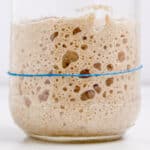
- In a small jar, combine 30g whole wheat flour and 30g lukewarm water. Mix it until it forms a thick paste. Place a rubber band at the level of the mixture so you can easily track its growth as well as a loose-fitting lid on it.
- Place your mixture somewhere warm and stable: I sometimes place it on top of the fridge, inside the oven with the light on (oven off), or near a warm appliance. Aim for a cozy, slightly warm spot, one that is not hot. We don't want to cook the mixture.
Day 2: Watch for the First Rise (The "False Rise")
- At some point, you may notice your starter doubles or even triples quickly and then falls. You might see large, uneven bubbles and a stinky smell. You might also see a gray, dark, or slightly discolored layer on top.
- What's happening: This is called a false rise. Early on, different bacteria inside the mixture become active before your starter stabilizes. They produce gas quickly, but they're not the ones we want long-term.
- When your starter rises and then falls, leaving marks on the jar, it means it’s active and has completed a healthy fermentation cycle. Once it falls, it’s simply hungry and ready to be fed again.
- When you see that early rise, scoop out and keep 30g of starter and transfer it to a clean jar. Add 30g flour and 30g water, then mix them all until you get a smooth mixture. Throw the mixture you scooped out in the trash.
- Why trash the discard at this stage: Your starter isn't stable yet. The early mixture has bad bacteria, doesn't taste good, and isn't ready for recipes. It's still developing its balance.
Day 3: You May See Another Big Rise
- Your starter might rise quickly again (even triple) and have both big and small bubbles. This means you're still in the early development phase, but improving. At this point, the good bacteria are starting to take over.
- What to do: Repeat the same feeding: 30g starter, 30g flour, and 30g water. Discard the rest.
Day 4: The "Quiet Phase" (Super Important Stage)
- Now at this point things may change. You might notice only a small rise (or almost none), fewer bubbles, and a mild fruity or slightly sour smell.
- What this means: This is the most important stage. Your starter is stabilizing, becoming more acidic, and building the right environment for yeast. It may look like it's slowing down, but it's actually improving!
- What to do: Stay consistent. Keep 30g of starter and feed it 30g flour and 30g water.
Day 5: Smell Changes and Small Rise
- As you continue feeding, you may notice a lemony, tangy smell and a cleaner, fresher aroma. This is a great sign. Your starter is developing healthy bacteria and balanced fermentation.
- What to do: Keep 30g of starter and feed it 30g flour and 30g water.
Day: 6 Bigger Rise
- Eventually, your starter will rise more noticeably, reaching 1 inch or more above the rubber band, and show a mix of bubbles throughout.
- What to do: Keep 30g of starter and feed it 30g flour and 30g water.
Day 7: The Breakthrough Moment
- You'll know your starter is ready when:
- It doubles in size consistently
- It rises and falls in a predictable pattern
- It smells pleasantly sour (not harsh or rotten)
- It looks airy and full of bubbles
- What to do: Keep 30g of starter and feed it 30g flour and 30g water.
Day 8: One Last Step (Don't Skip This)
- Once it starts doubling consistently, feed it 2 to 3 more times. This strengthens it so it performs reliably when you start baking with it.
Notes
Once the sourdough starter is active, keep it on the counter if you bake frequently and continue feeding it daily. If you don't bake as frequently, keep it in the fridge and feed it ~once a week or the night before baking.
Nutrition
Serving: 1tablespoon | Calories: 1020kcal | Carbohydrates: 216g | Protein: 40g | Fat: 8g | Saturated Fat: 1g | Polyunsaturated Fat: 4g | Monounsaturated Fat: 1g | Sodium: 21mg | Potassium: 1089mg | Fiber: 32g | Sugar: 1g | Vitamin A: 27IU | Calcium: 111mg | Iron: 11mg