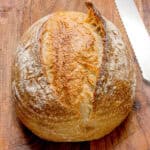
Sourdough Bread
Made with an active sourdough starter, pantry staples, and a simple process, this Sourdough Bread recipe is perfect for beginners and first-time bakers. It can be made in a single day or split over two days, and there are no complicated techniques required.
Servings: 1 loaf (about 8-10 slices)
Calories: 1820kcal
Equipment
Ingredients
- 500 grams flour all-purpose or bread flour
- 325 grams water
- 100 grams active sourdough starter [fed 4–8 hours prior, bubbly and at peak]
- 7 grams salt I use 7g, but you can go up to 10g if you prefer
Instructions
Step 1. Mix the Dough
- In a bowl, add your sourdough starter, then the water. Whisk until it looks milky. Add your flour and mix the ingredients until everything is combined. It'll look shaggy and messy.
Step 2. Let It Rest (30 Minutes)
- Cover it and let it sit for 30 minutes. This step hydrates the flour fully and makes the dough easier to work with later.
Step 3. Add the Salt
- Sprinkle salt over the dough. Use your hands to work it in: I like to pinch, fold, press it into itself. Make sure it's mixed in well.
Step 4. Stretch and Folds (3 Sets, 30 Minutes Apart)
- Do 3 rounds of stretching and folding, with 30 minutes rest between each.
- For each round: grab the top of the dough, stretch it up and fold it over the center. Then do the same with the bottom, then each side. You're working the dough like a compass: north, south, east, west. Cover the dough between rounds. You'll see the dough get smoother and stronger each time.
Step 5. Bulk Fermentation (4–6 Hours at Room Temperature, or Overnight in the Fridge)
- After your last stretch and fold, cover the bowl. Let it rise at room temperature (68–72°F is ideal) for 4–6 hours, or place it in the fridge overnight.
- You're looking for:
- Visible growth (not doubled, just noticeably fuller)
- Bubbles that are visible on the surface
- A slight dome on top
Step 7. Shape the Dough
- Lightly flour your dough and work surface and turn the dough out. Carefully shape it into a rectangle. Fold the top third down, then fold the bottom third up and over it. Turn the dough 90 degrees and roll it up like a burrito, applying gentle tension as you go. Don't crush the air out.
Step 8. Final Proof (1–2 Hours at Room Temperature, or Overnight in the Fridge)
- Dust the shaped dough with rice flour or gluten-free flour (to prevent the dough from sticking to the banneton). Place it seam-side up in your banneton or a bowl lined with a lightly floured towel. Let it proof at room temperature for 1–2 hours until it springs back slowly when you poke it. Or refrigerate it overnight for better flavor and easier handling. The cold dough should still pass the poke test before baking.
Step 9. Preheat the Oven
- Place your Dutch oven (with the lid on) in the oven and preheat it to 450°F. Let it heat for at least 30 minutes so it's fully hot.
Step 10. Score and Bake
- Place your dough on parchment paper then slash the top with a razor or bread lame at a 30-45 degree angle, using a swift, confident stroke that's about 1/4 inch deep. This slash guides the bread to expand upward. Place it carefully into the hot Dutch oven. Bake it covered for 30 minutes to trap steam, then uncover and bake it for another 15–20 minutes until it's deep golden brown. Check that the internal temperature reads 205–210°F with an instant-read thermometer inserted into the center.
Step 11. Cool
- Take the loaf out and let it rest on a wire rack for at least 1 hour before slicing. This lets the inside set. Cutting into it too early will lead to gummy bread. Nobody likes gummy bread.
Notes
Store sourdough bread in a paper bag or wrapped in a towel on the counter for 2-3 days.
Nutrition
Calories: 1820kcal | Carbohydrates: 382g | Protein: 52g | Fat: 5g | Saturated Fat: 1g | Polyunsaturated Fat: 2g | Monounsaturated Fat: 0.4g | Sodium: 2739mg | Potassium: 536mg | Fiber: 14g | Sugar: 1g | Calcium: 86mg | Iron: 23mg